

We all know the pictures of the astronauts on the ISS floating around. We also suspect that a lack of gravity is bad for the body as the muscles go weak and such.
Why don’t spaceships just rotate to cause the effect of artificial gravity through centrifugal forces?
the one in space odyssey did.
The ISS is primarily designed to research the effects of microgravity and other space environment issues. Hard to study zero g manufacturing when your station has artificial gravity.
True
Small ships would have to rotate really fast to make 1G, and it’s not worth the trouble if nobody lives there permanently.
Even if a small ship rotates fast that would ‘t work. If you have a small diameter then there would a huge difference between the perceived ‘gravity’ at your head vs at your feet.
Not to mention the coriolis effect wreaking havoc on your inner ear.
Not a problem when you’re sleeping lying down.
Im not really sure what you mean by lying down? You’re not always lying down. Surely gravity is less relevant when you’re lying down anyway.
… I dont have a good understanding of physics but sci-fi novels suggest a few problems on small ships.
The first problem is the difference in gravity between your feet and your head. In a small command capsule like Artemis 2, your head might be near the centre at 0g while your feet are at the outside at 1g or even 2g. How hard does your heart need to pump blood? Would this create some kind of blood pressure problem?
The next problem is how it would “feel”. Is it called the Coriolis effect?
In a small ship you might experience 1g, but it would feel like you’re being spun around in a washing machine. Your ears would tell you that you’re constantly changing direction and it would 100% fuck you up. In sci-fi the spinning thing needs to be large enough that some g-force is produced without you feeling that sense of motion, or at least for ot to be small enough that you get used to it.
Another problem I just made up is that if there’s no gravity then 100% of the inner surface area can be terminals and readouts and equipment. If you create gravity then you need a floor to walk on which will use a heap of surface area.
no, but the force of the rotation squeezing most of your blood into your head or feet might be a problem for you
Why? It’s still just 1G.
Do you faint when descending in an elevator?
Why? It’s still just 1G.
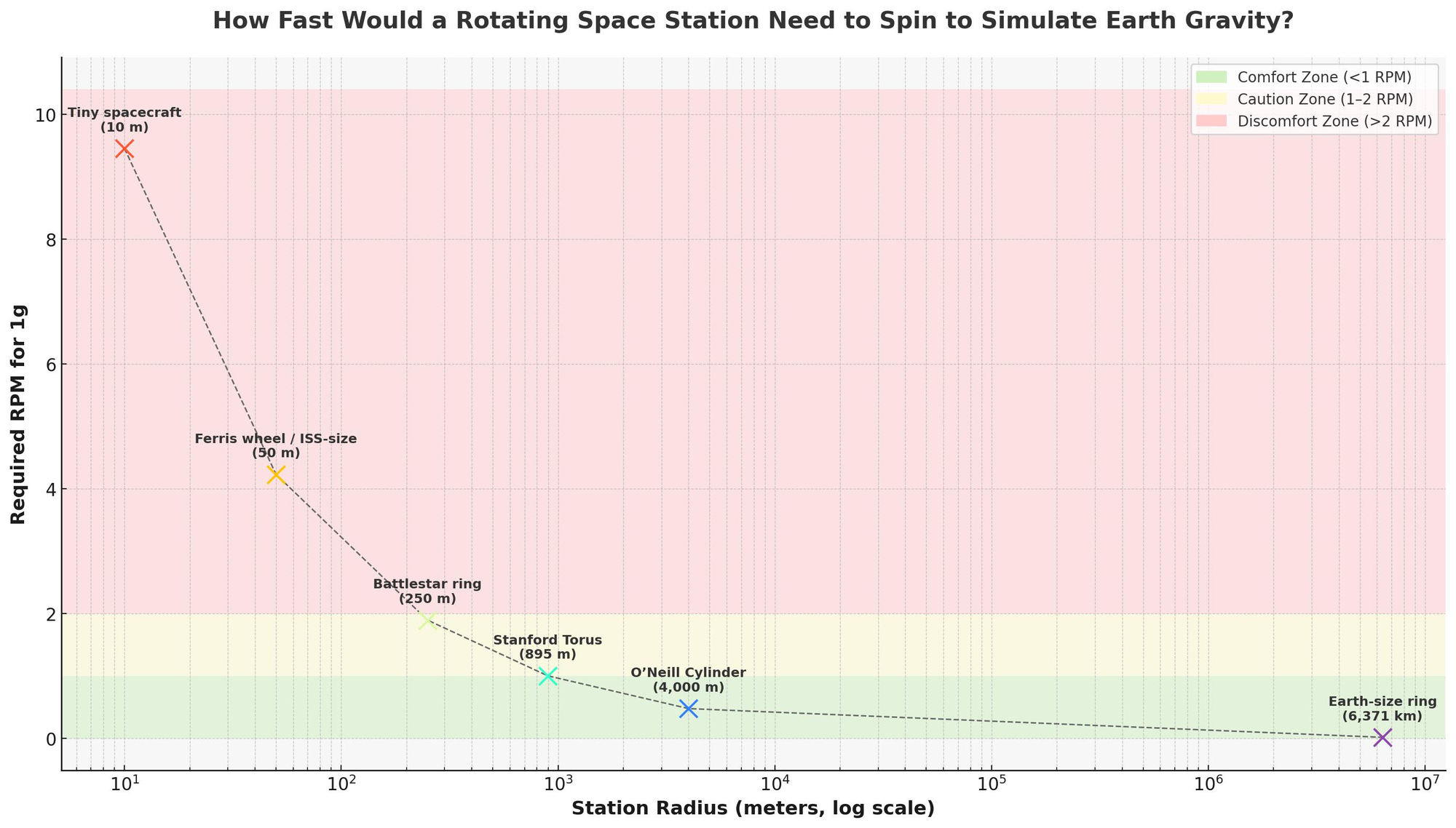
what is this data based on?
https://ntrs.nasa.gov/api/citations/20070001008/downloads/20070001008.pdf
At body motions or centrifuge rotation rates that are small in magnitude, the effects of the Coriolis force are negligible, as on Earth. However, in a centrifuge rotating at several rpm, there can be disconcerting effects. Simple movements become complex and eye-head movements can be altered: turning the head can make stationary objects appear to rotate and continue to move once the head has stopped. This is because Coriolis forces also create cross-coupled angular accelerations in the semicircular canals of the inner ear (see Figure 4-01) when the head is turned out of the plane of rotation. Consequently, motion sickness can result even at low rotation rates (<3 rpm), although people can eventually adapt to higher rates after incremented, prolonged exposure (see Chapter 3, Section 3.1).
You said force of rotation but the chart is talking about RPM.
Still only 1G.
You said force of rotation but the chart is talking about RPM.
yes, you have forgotten to take into account the Coriolis force and the effect it would have on your astronauts.
https://ntrs.nasa.gov/api/citations/20070001008/downloads/20070001008.pdf
At body motions or centrifuge rotation rates that are small in magnitude, the effects of the Coriolis force are negligible, as on Earth. However, in a centrifuge rotating at several rpm, there can be disconcerting effects. Simple movements become complex and eye-head movements can be altered: turning the head can make stationary objects appear to rotate and continue to move once the head has stopped. This is because Coriolis forces also create cross-coupled angular accelerations in the semicircular canals of the inner ear (see Figure 4-01) when the head is turned out of the plane of rotation. Consequently, motion sickness can result even at low rotation rates (<3 rpm), although people can eventually adapt to higher rates after incremented, prolonged exposure (see Chapter 3, Section 3.1).
in other words, the higher the RPM needed to generate 1g, the worse the effect of the Coriolis force on the astronauts.
interestingly bigger ships would have to rotate faster than small ships to achieve 1g btw
this is due to smaller ships having a larger curvature so less velocity is needed
edit: no wait i just did the maths again and you’re right. smaller ships need lower absolute velocity of the outside walls, but angular velocity is higher.
Yes, but the smaller the ship, the worse the Coriolis force will be. Imagine a 10m corridor with opposing gravity on each end, and no gravity in the middle. Travelling across would be extremely disorienting.
i think that would be so much fun!
For clarity: I don’t know for certain. I am not involved in the community, not an engineer.
Opinion: It’s incredibly difficult to do. A spinning station needs to be designed to do such a thing. It needs to be balanced and have thrusters positioned in such a way to both spin up and maintain the rotation as it goes. The ISS has been built and expanded over decades by tons of new science modules over time as new breakthroughs happened.
Spinning objects can behave in strange ways and having a regularly shifting center of mass can be a challenge by itself, and that’s before you start planning for yet uncertain experiments to bring aboard.
In addition to this, it would be an ENORMOUS challenge to dock with a station that is spinning, and the added danger to do this (or increased fuel consumption of spinning down and then spinning back up) just isn’t worth it. The alternative of maintaining a central core that is static relative to the spin wastes power and creates a massive risk (more moving parts, especially those which might create friction against metal aren’t easy to maintain in space).
Also, a small spinning station is much harder than a massive spinning station because it would have extremely noticeable differences from normal gravity to the people on board. Your head and feet would likely be moving at noticeably different speeds, which by itself is disorienting, but moving either towards or away from the direction of the spin would feel different (dropping an object would mean it falls away from the direction of spin).
Lastly, maintenance would mean that every single EVA either wastes a tremendous amount of fuel to spin down/up again, or risking flinging a person into space every time they exit.
Realistically, on a much larger station, artificial gravity via spinning might be a fantastic idea, especially for longer-term living aboard, but for the ISS, given its history, its goals, and especially where it’s at, it’s just not a great idea.
Could you not solve the spinning-ring-friction problem via magnets? The same way maglev trains work.
It doesn’t change that this isn’t really a great idea for the ISS, but that’s an obvious solution to the problem of having a static central core.
This is already quite a bit beyond where I have any definite knowledge, but I guess if you had a core completely separated by magnets that might work, but you’d still need points of connection for people who docked to join the actual ring from.
If you did that, the core would also need its own propulsion system to spin down and spin up so that anyone docking could actually go out into the ring.
It’s worth noting here, too, that the inner core would need to spin like crazy fast for a small station to have anywhere close to 1G in the ring, so that would be its own fun thing in the core.
You would need a pretty large radius to generate stable rotational gravity. If the radius is too small, the speed of rotation would make standing or walking nearly impossible. The larger the radius, the more imperceptible the rotational effects would be.
ok so i did some calculations:
If your ship is 9 m in diameter (just chosen at random, not because Starship is by chance 9 m in diameter)
that means x = r*cos(omega*t) and x’’ = r*omega^2*-cos(omega*t) = 1g for t = 0 implies r*omega^2 = 10 m/s², r ≈ 4.5 m, omega ≈ 1.5 rad/s
so the ship would have to rotate with roughly 0.24 rotations per second or 14 rpm. seems doable to me. the outer walls would move with 6.7 m/s or 24 km/h.
Have you ever been in one of these?
You can easily sit on the wall while it’s spinning, and it actually feels pretty normal. But, if you try and stand up and walk around…you’re going to have a very bad day.
actually i have been, and i have attributed it to the device not providing consistent centrifugal forces. instead, gravity interferes and makes it inconsistent. which would not happen on a spaceship.
Doable, not practical. Another major concern is the induced dizziness and general discomfort from such a small circumference. If you stand up straight, your head moves significantly slower than your feet. There are more effects that humans don’t do well with.
In addition keep in mind that this implies significant mechanical complexity the moment you don’t rotate the whole craft, but only a section or ring. If you do rotate all of it, simple tasks like taking a photo become… cumbersome.
Also like others have said, it’s not a permanent residence for anyone, and the main goal of the ISS is the study of low- or micro-gravity.
ISS has thrusters that push it up/ forward from time to time. It’s practically permanently falling on / around earth, to create the lack of gravity. Up there gravity is nearly pulling as strong as here
We can’t launch anything very big, and things that are constantly spinning are hard to engineer for 100% reliability especially if you have to assemble them in orbit.
And since we can’t launch anything very big anyway, it would make sense to maximize interior space. Leaving two sides of the craft basically unusable as a floor and ceiling reduces available surfaces in a space by 1/3.